
You can encrypt a reply or a new send from an alias using the addy.io public key. The message is encrypted before it arrives at addy.io and is automatically decrypted on the addy.io mail server before being forwarded on to the correct destination. This gives an extra layer of privacy for the message content. This article describes the idea and how to use this option; exact steps may depend on your mail client.
How it works
- addy.io provides a public key (available here) that you (or your mail client) use to encrypt the reply/send.
- The message is sent encrypted to the addy.io mail server and is then automatically decrypted.
- After being automatically decrypted, the message is forwarded on to the correct destination so they receive a normal, readable email. This protects the content in transit from your real email provider to the addy.io mail server.
This is an advanced feature that is useful if you wish to hide the contents of your reply/send from your email provider such as Gmail. You need a mail client or workflow that can encrypt with the addy.io public key such as Mozilla Thunderbird.
Using the addy.io public key to encrypt
- When sending from an alias (new conversation) or replying, compose the message as usual.
- If the option is offered, enable Encrypt or select the addy.io public key before sending.
- Send the email. It will be encrypted according to the method you chose.
Your email client may complain that the public key does not match the identity of the email address you are encrypting to.
If you are using Mozilla Thunderbird then you will need to use their pgp alias rules configuration - https://support.mozilla.org/en-US/kb/openpgp-recipient-alias-configuration, this is because by default they do not allow you to encrypt an email using a public key that does not match the receiver's identity.
Here's an example config that you can use for your openpgp_alias_to_keys.json:
{
  "description": "Thunderbird OpenPGP Alias Rules",
  "rules": [
    {
      "domain": "anonaddy.me",
      "keys": [
        {
          "description": "Testing decrypt replies/sends on addy.io",
          "fingerprint": "26A987650243B28802524E2F809FD0D502E2F695"
        }
      ]
    }
  ]
}
This will allow you to encrypt all messages sent to aliases *@anonaddy.me using the no-reply@addy.io public key. Add or modify the alias domains as required.
Encrypting a reply/send using FairEmail (Android)
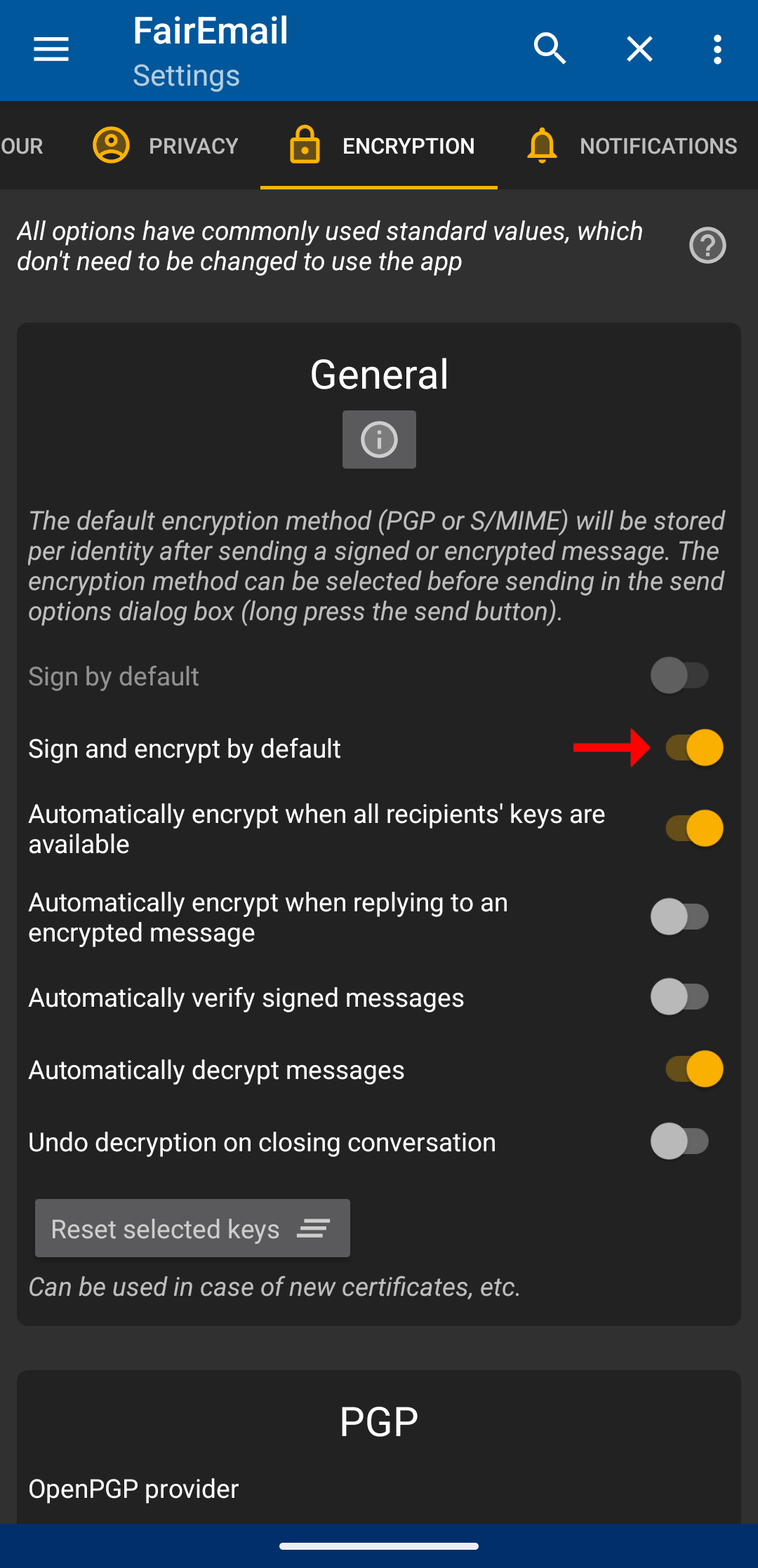
FairEmail on Android uses OpenKeychain for PGP. Import the addy.io public key once, then encrypt each reply or new send before it leaves your device.
You need FairEmail, OpenKeychain, and OpenKeychain set as the encryption provider in FairEmail. If the padlock never appears when composing, check FairEmail Settings > Encryption first.
Import the addy.io public key (one-time)
- In FairEmail, open Settings (gear icon) > Encryption.
- In the PGP section, tap Import key +.
- Search for
no-reply@addy.io(or paste the addy.io public key fingerprint:26A987650243B28802524E2F809FD0D502E2F695). - Select the key and tap IMPORT in OpenKeychain.
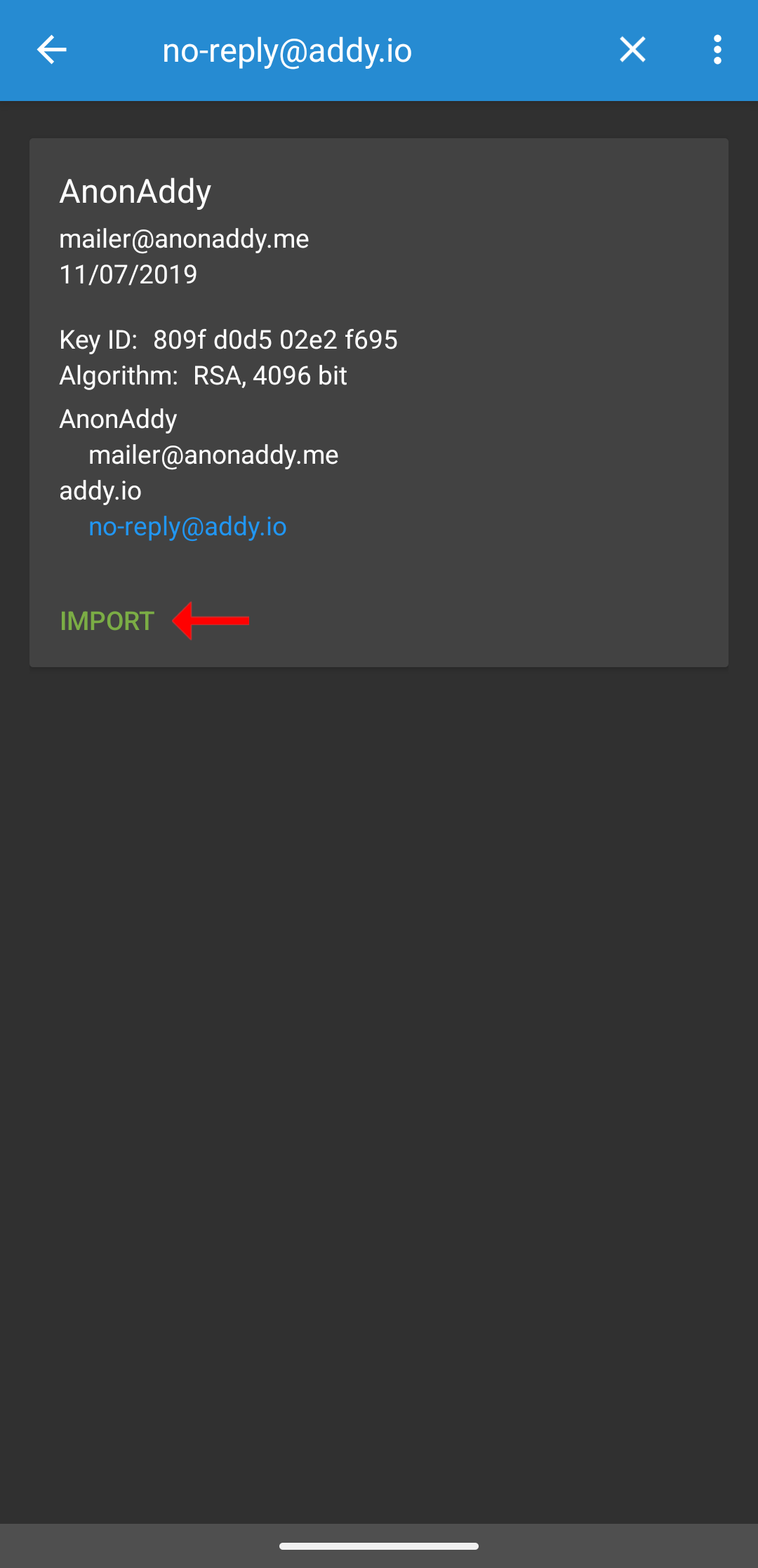
You only need to do this once per device.
Encrypt and send a reply or new message
- Compose your message as usual. For a reply, use the address addy.io gave you in the forwarded email. For a new send, use the send-from address from Sending email from an alias.
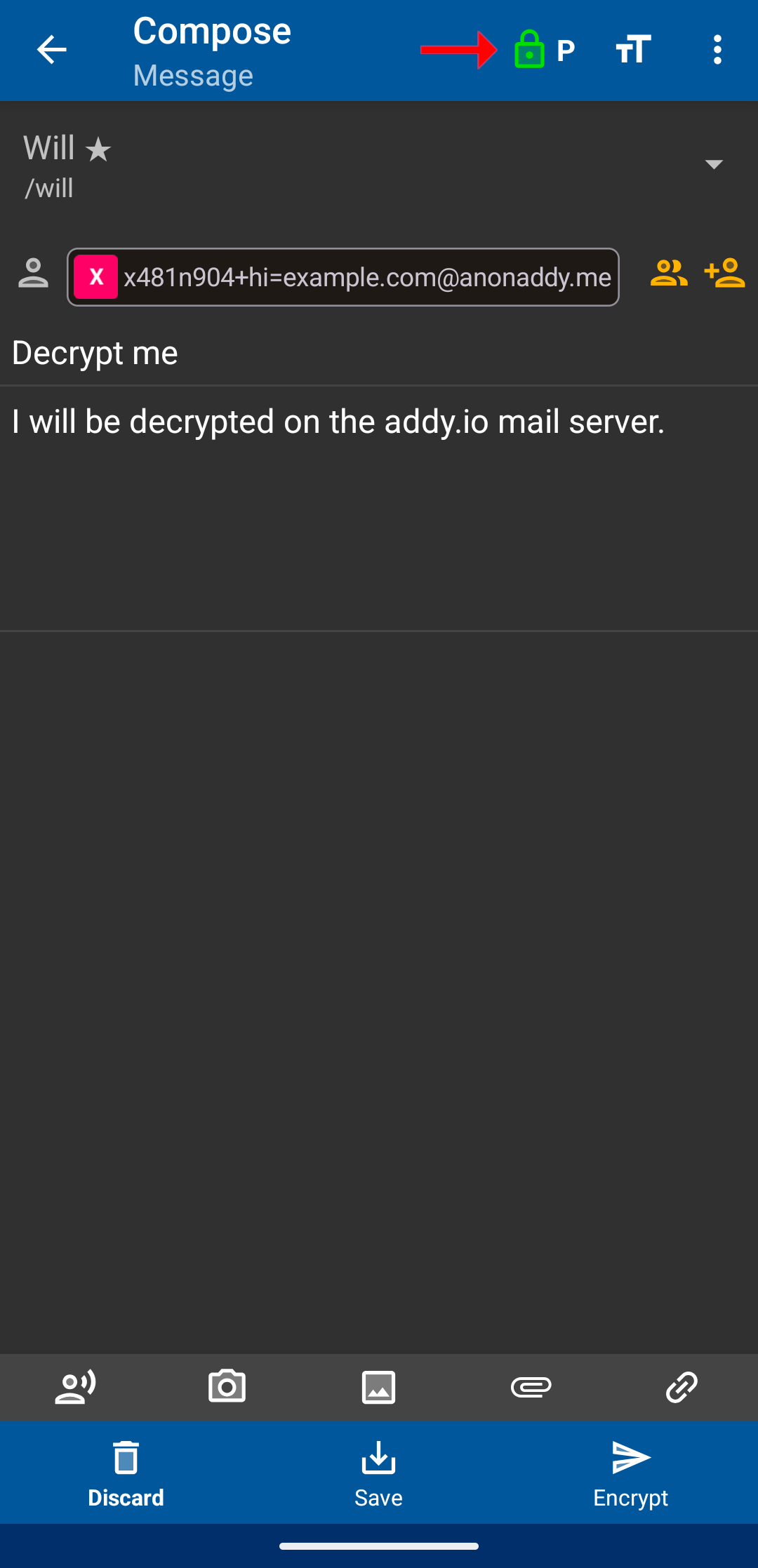
- Check that the green padlock is visible on the compose screen. If it is grey or missing, PGP is not available. Check that OpenKeychain is installed and enabled in FairEmail encryption settings.
- Tap Encrypt (bottom right).
- When OpenKeychain asks you to choose a key, pick the entry for
no-reply@addy.io. The list may also showmailer@anonaddy.me(or similar). That is another identity on the same key, not a different key. Either identity works as long as the fingerprint matches addy.io's public key. - Set the mode to PGP encrypt-only, then tap SEND.
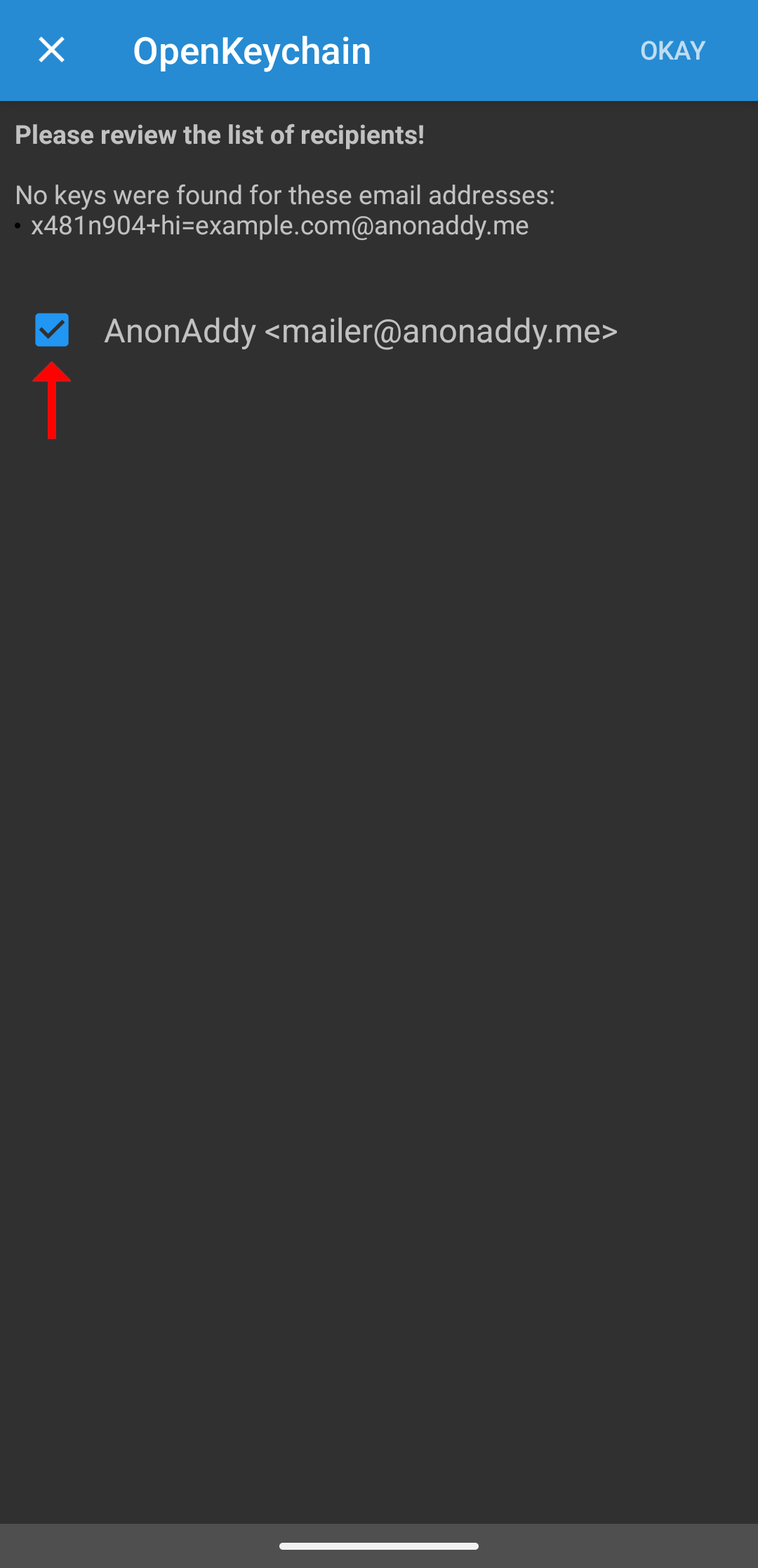
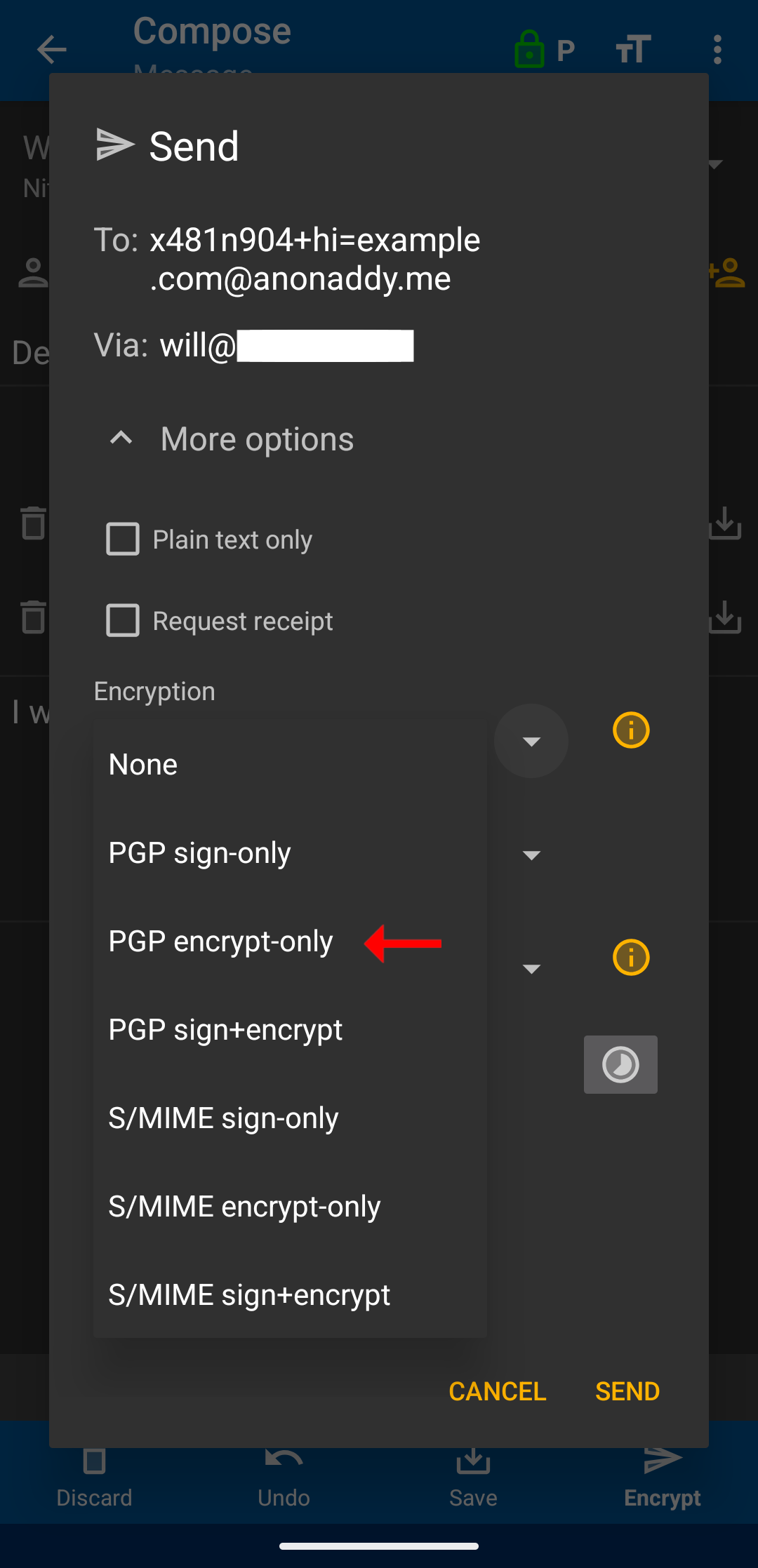
FairEmail may warn that the public key does not match the To address on the message (for example your alias or encoded reply address). That is expected. Use the no-reply@addy.io key anyway, the same idea as Thunderbird's OpenPGP alias rules above.
For a general overview of encrypted reply/send, see Sending an encrypted reply/send from an alias.