
addy.io supports different types of email aliases depending on the domain. The two main kinds are standard aliases (unique to you) and shared domain aliases (on a domain used by many users). This article explains what each type is and how they behave. For formats like random characters or random words, see Terminology.
What is an email alias?
An email alias is an address that forwards mail to another address-in addy.io's case, to one or more recipients you have added. When someone emails your alias, addy.io receives it and forwards it to your real inbox. You can reply or send from the alias so the other person sees the alias address, not your real one.
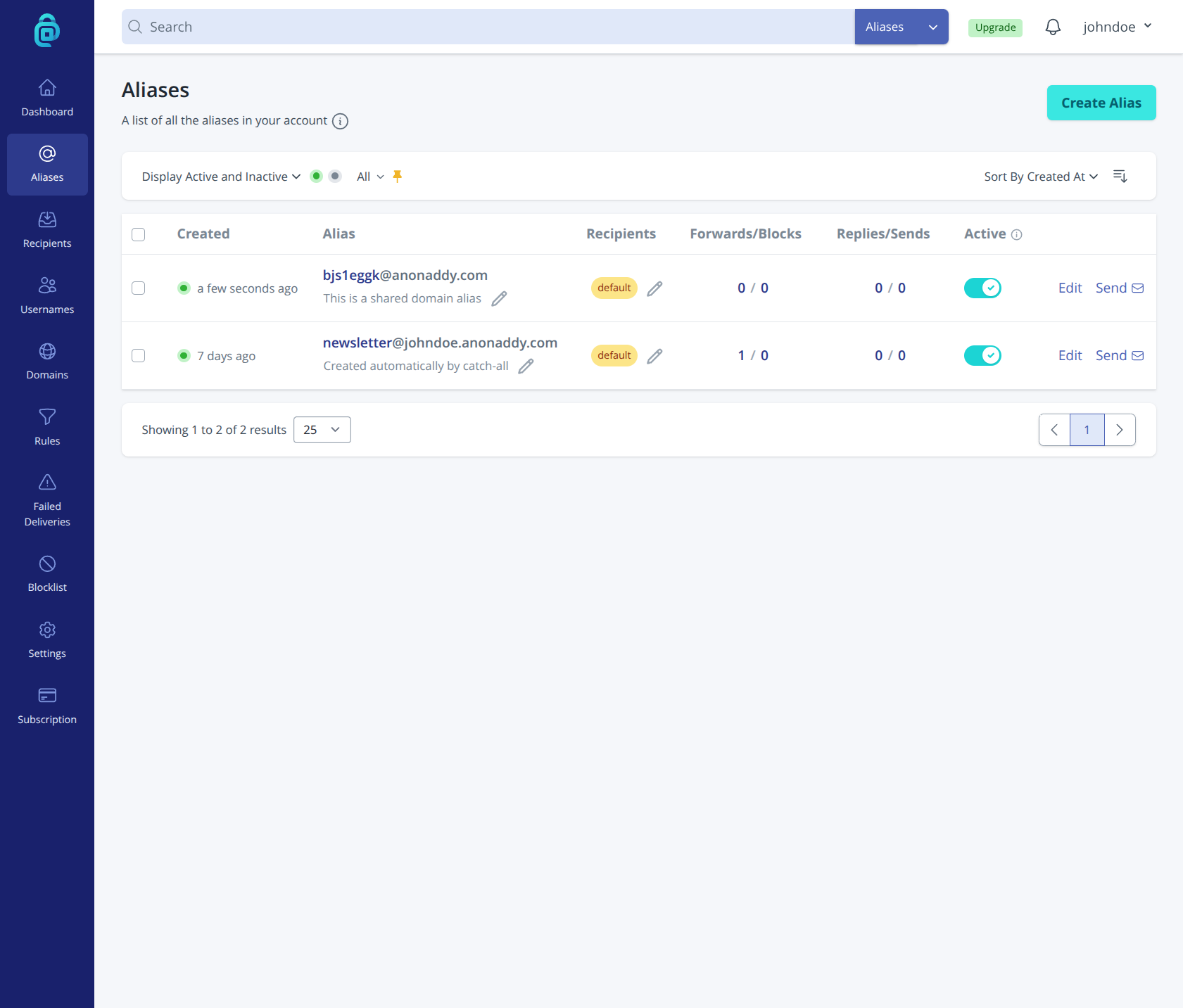
Standard aliases
A standard alias uses a domain that belongs only to you. Examples:
- Your username subdomain - e.g. hello@johndoe.anonaddy.com or hello@johndoe.anonaddy.me (where johndoe is your username).
- Your custom domain - e.g. newsletter@yourdomain.com after you have added a custom domain.
- An additional username’s subdomain - e.g. shop@janedoe.anonaddy.com if you have added additional usernames.
Because the domain is unique to you, standard aliases can be created on the fly: as soon as the first email is sent to that address, addy.io creates the alias and forwards the message. You do not need to generate them in the dashboard first. This behaviour is called catch-all. You can also create them in advance via Creating new email aliases (Create Alias on the website), the browser extension or mobile app.
Shared domain aliases
A shared domain alias uses a domain that many addy.io users share. The most common example is @anonaddy.me (e.g. circus.waltz449@anonaddy.me). Other shared domains are available depending on your plan.
Because the domain is shared, these aliases must be generated before use. You cannot create them on the fly by giving out an address; you must use Create Alias on the website, the browser extension, mobile app or the API. Once it exists, you can give it out and receive mail. Shared domain aliases often use random character or random word formats so they are hard to guess and not tied to your username.
There is usually a limit on how many shared domain aliases you can have; aliases at your own username subdomain or custom domain do not count toward that limit. See the pricing section for more details.